Recent development of modern AI agent systems such as Claude Science, Co-Scientist or Robin presents new opportunities for research. The workshop will focus on designing AI agents across various research fields, from methodology (orchestration of agents, benchmarking) to the underlying concepts (ie. knowledge graphs), their implementation on HPC clusters and security of these systems (guardrailing, sandboxing), as well as current options available for researchers at the Charles University. A part of the workshop will be dedicated to discussions to share experiences from working with these systems to deepen our understanding and knowledge of them.
The programme will include talks by experts in the field from partnered universities of the 4EU+ alliance (Sorbonné Université, University of Warsaw, Heidelberg University), and by experts from the AI interest group.
The workshop will be in English.
Location and time:
1.10. - Areál Karlov, Faculty of Mathematics and Physics, Charles University
2.10. - Kampus Hybernská
First day - agenda from 09:00 until 18:30
Second day - agenda from 09:00 until 15:00
The location and agenda is subject to change.
More information regarding the venues and agendas will be sent to attendees after successful registration.
Registration of attendees and speakers:
The workshop is open to employees and students of Charles University free of charge. The registration is open on this link. The number of attendees is limited.
We also welcome the opportunity to present at the workshop as a speaker. If you're interested in contributing to the workshop in this way, please fill out this form on this link. We will reach out to you after careful assessment of all applications. The number of speakers is limited.
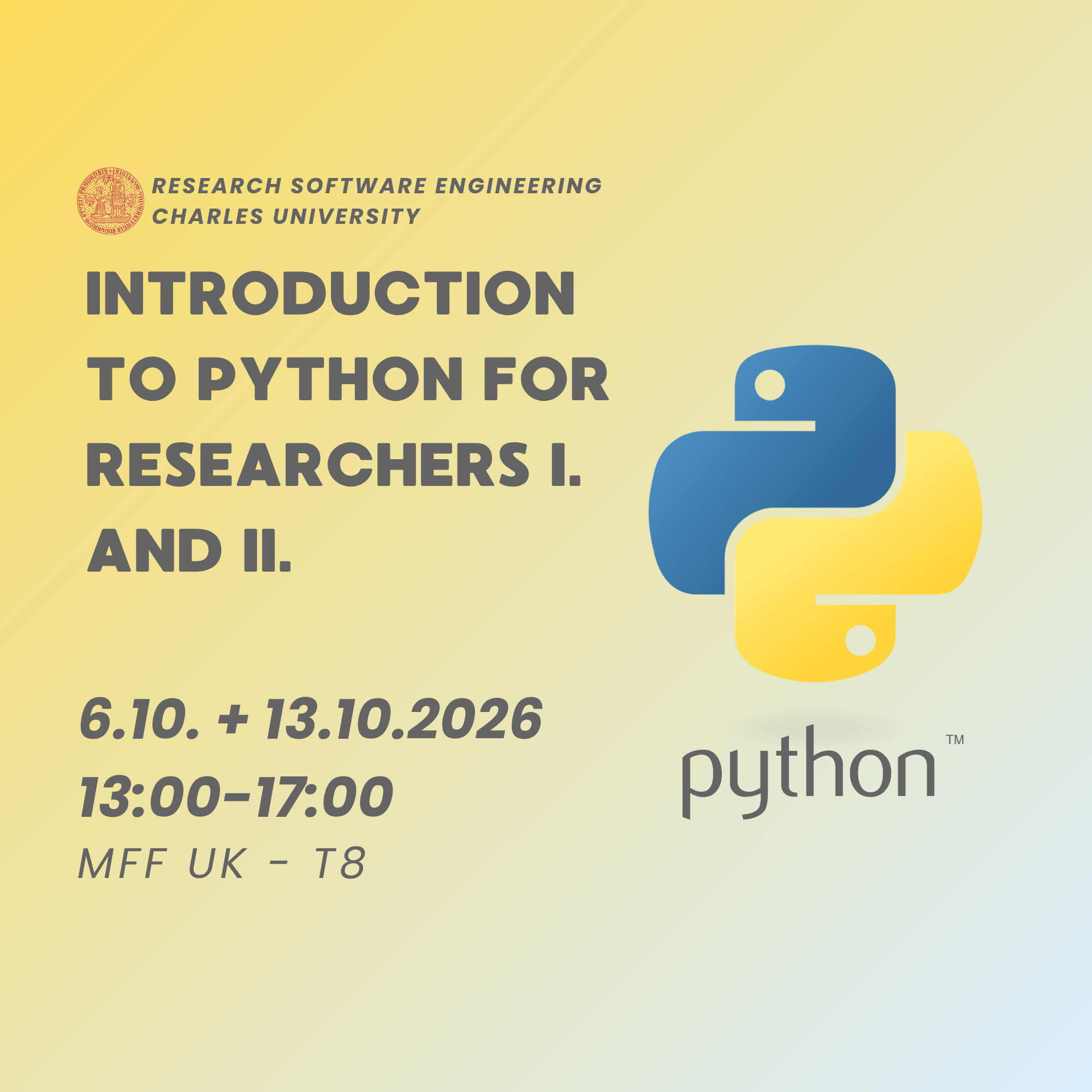
This two-day introductory course provides a practical foundation in Python programming, designed for beginners and researchers who want to start working with Python for data analysis and scientific tasks. The course is hands-on and practice-oriented, with examples and exercises throughout both afternoons. By the end of the course, participants will be able to write simple Python scripts, process data from files, and perform basic numerical analysis using NumPy. The course is organized by the Research Software Engineering (RSE) Center at Charles University.
Day 1 focuses on the basics of Python and working in Jupyter Notebook. Participants will learn how to work with variables, understand core data types, and use essential data structures such as lists, tuples and dictionaries. The day also introduces built-in functions and teaches participants how to define their own functions. Day 2 introduces control flow and practical data handling. Participants will learn how to use conditional statements and loops to control program logic. The course then moves to working with files (reading and writing data) and introduces the NumPy library for numerical computing, including arrays, basic statistics, element-wise operations, handling missing values (NaN), and simple data normalization.
Both days are held at the Faculty of mathematics and physics at Troja, V Holešovičkách 747/2. Registration is open on this link.
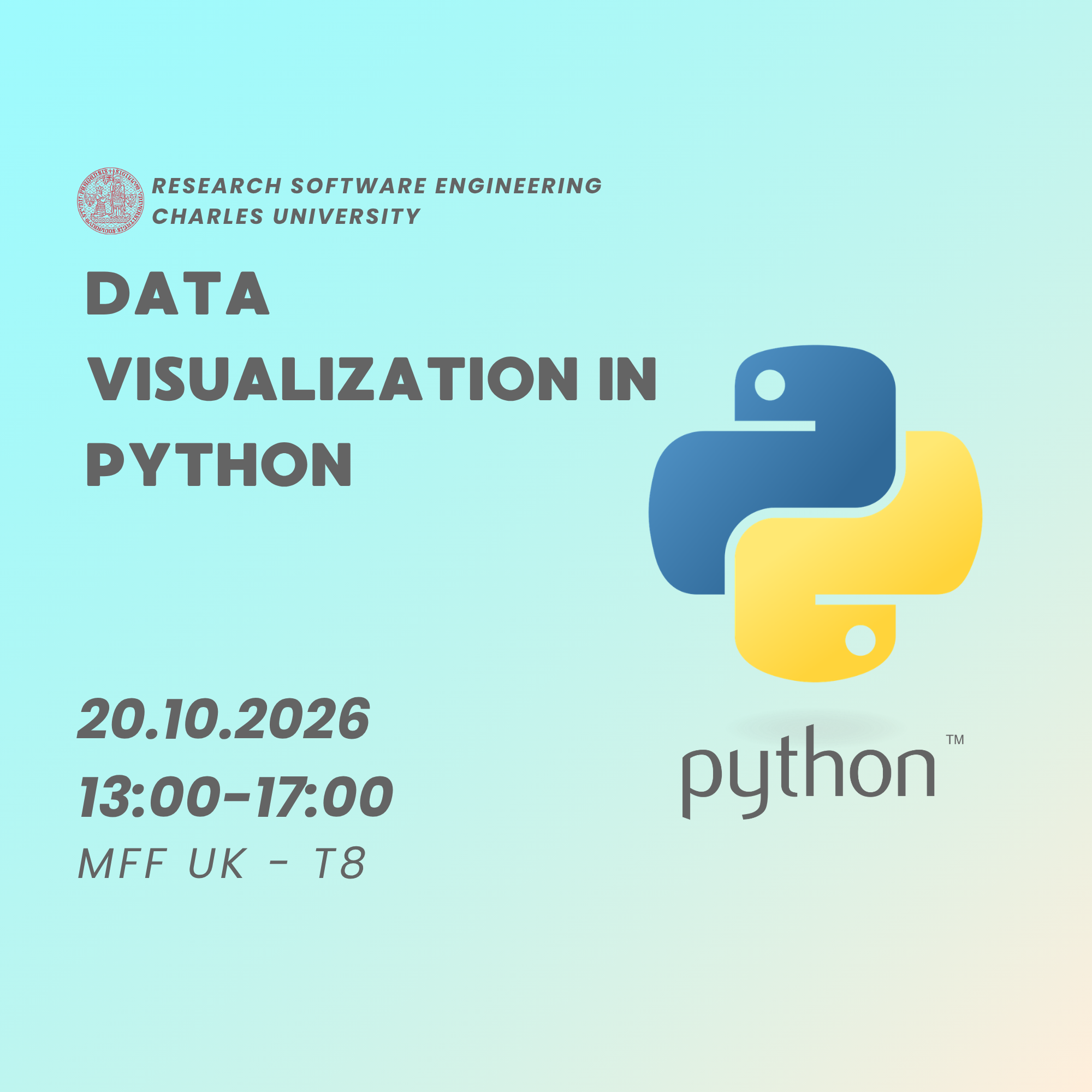
This one-afternoon course focuses on practical data analysis and visualization in Python using Pandas and Matplotlib. The course is preceded by a two-day seminar Introduction to Python for Researchers I and II. The course is organized by the Research Software Engineering (RSE) Center at Charles University.
It is designed for participants who already have a basic understanding of Python and want to apply their skills to real data. The entire session is hands-on and task-oriented: participants work through guided exercises and practical problems, learning how to load, clean, analyze, and visualize datasets step by step. The emphasis is on active problem-solving and building confidence in working with real-world data.
Registration is open on this link.

Introductory crash course of high performance programming principles and strategies demonstrated on the computational cluster Chimera. After the course, the participants will know how to design parallel jobs, submit and monitor them via SLURM scheduler. The course will cover the basics of openMP and MPI parallel coding paradigms and basic usage of GPU. Majority of examples will be in Python. Prerequisites: Basic knowledge of Linux Bash and Python programming language.
The course is divided into two 2hr sessions with a 1hr lunch break in-between.
The course is in English and will take place in room N2 in the IMPAKT building at the Faculty of Mathematics and Physics. Registration is open on this link.